Showing posts with label Wealth. Show all posts

In Decision Not Indecision

Every mother knows when to ignore a child throwing a tantrum and when to heed an actual cry for help. This is the same for certain attention-seeking noises that have been wailing out of the market recently. We will address just two of these concerns.


First, the Dow Jones has been rising steadily while the Chinese market has moved sluggishly at best. All in all, a total of $6.5 billion has been redeemed from emerging markets like China this year. On the flip side, developed market equity funds like the US have booked inflows consistently for weeks, attracting more than $52 million in the same period. Yet, there has been no call from your adviser to make any adjustments to your portfolio. You may be interested to know why we remained seemingly indifferent in reacting to these fund flows. Take a closer look, and you will see that our inaction, is not indifference.

 Short Term Pain, Long Term Gain


Let us explain it this way. China is working out some teething problems with inflation. The pressure of escalating inflation in emerging markets has spurred policymakers to take drastic cooling measures starting from late 2010. These measures have caused short term fund flows to flow out from the emerging economies to the developed markets, as investors are concerned that the cooling measures would cause slow growth, thereby affecting corporate profits. These teething pains while uncomfortable, are an unavoidable part of China's growth story.


However, we understand that investors such as yourself may have entertained the thought of avoiding these short-term discomforts. Should you have reduced your holdings in emerging markets, and direct the funds towards large caps in the US? Let us pause a moment to reassess the situation. In the art of warfare, the ancient Chinese war adviser, Sun Tze always does a detailed assessment of his enemies. He goes to war only when he has done his risk to reward calculations.


Why Less is More


Our call to buy into Malaysian equities two years back is an example of how we took advantage of capricious market trends. At the time, speculative funds, known as 'hot money' flowed into Malaysia due to positive changes in their foreign policy. Hot money typically flows from one market to another unpredictably. In that case, we rode on this trend in order to make short-term profits for our clients.


So why do we not see the need to attend to these market noises now? Isn't the media focusing most of its attention on the speculative net redemption from markets such as China? Shouldn't we do something about the situation? Well, we continue to believe that cooling measures taken by the Chinese government will come to a halt eventually. Funds will then flow back to the Chinese market. If we take action to pull out of China now, we may risk missing out when hot money comes flowing back into China. That would mean a huge opportunity cost for your portfolios. Since the JNP Investing Commitee has never taken interest nor liberty to time the market, we choose to stay status-quo. And we will continue to faithfully invest in China on a regular basis in anticipation for the Chinese market to rebound. We believe the rather annoying market noises will soon stop when your portfolio starts behaving as desired. For the moment, it is our belief that inaction is a better way of achieving long-term rewards in your portfolio.


The American Tale


We were not surprised by the upside of US equities either. Global news reports have long flooded investors with gloom and doom warnings of investing in the US. Yet, the committee decided to sweep up many strong large caps at a cheap value. While funds flowed out of the US, we continued to secure our foothold. We retained a minimum exposure of 15% in US equities throughout the crisis. The reason is simple. We did not want to see our clients missing out on the surge of US equities when the recovery took place. Often, the rally begins subtly and by the time the media captures the rally, it is already too late. 'Sexy' prices remain elusive to those who are reactive rather than preemptive.


Russia on Santa's List


Should good little kids always be rewarded with candy? It depends, doesn't it?


While money has been flying out of Brazil, India and China, Russia has been an exception. Global fund managers believe Russia to be the only country now to attract new money among the major emerging markets. We believe that Russia will benefit greatly from rising oil prices and is likely to grow in economic earnings this year. Globally, many even see Russian shares as proxies for investments into commodities.


For these reasons, fund managers are keen to build up their Russian exposure. In fact, the number of global fund managers now recommending Russian securities and assets as a good investment rose from 50 percent in January to 88 percent in February. If Russia were a kid, I'd say he would easily make it to Santa's 'Good' list.


Good Kid Bad Teeth


Our investing committee was naturally interested to explore this market, and capture any opportunities if present. We are well aware that the Russian Trading System (RTS) is still trading at a good value.


Nevertheless, a number of reasons persuaded the committee against investing into Russia. We have not given candy to this good little kid. Because on closer inspection, we found that he has tooth decay! What do we mean?


The political structure of Russia remains heavily influenced by their ex president, the current prime minister, Mr Vladimir Putin. On one hand, this can mean political stability and should induce us to see Russia as an attractive investment. However, the political dominance of this one man raises some concerns. What will happen to the RTS should this prominent figure be removed from the political scene?


Plagued with Plaque


With the dominance of state in major Russian corporations, the market is rather unfriendly to investors. Such an environment may not be able to retain foreign funds for the long term.


Most importantly, the recent fund flows into the Russian market is most likely induced by surging oil prices. Admittedly, there is a huge correlation between Russian mutual funds and energy funds. However, our research shows that the former has not outperformed the latter. As such, we concluded that sticking to energy would make more sense than taking a chance on Russia. We may increase our exposure to energy, or energy related investments due to the potential we see in this sector. However, we are unwilling to take a chance on Russia due to the inherent political risks on the economy. At the moment, we remain comfortable with the allocation in this sector. We believe that it is the optimum percentage to balance the risk-reward ratio.


From history, too many investors attempt to leverage on the news in hopes of riding waves of hot money. Too often, they find themselves entering the trend too late and unable to exit on time. To ensure your portfolio behaves up to expectations, it is critical to carry the right investing attitude.


In JNP, while others time the market, we tame our framework. We will continue to help you position your monies ahead of the business cycles, being opportunistic to profit from situational anomalies, while preventing permanent loss of your capital.

Read more...

Beware: Inflation Running on a Full Tank

Inflation is probably not a new term to you if you have been in touch with the news. But, have you ever paused for a moment and really thought of how it might impact you? For those who have been treating this as another fascinating topic to be discussed over coffee, here's something for you. At JNP Kakis, we've prepared a special news brew that will keep you wide awake:


2010 ended well for many of our clients, families and friends. Employment opportunities have picked up, bonuses that were frozen in previous years were paid out and many even got a pay raise. All in all, things seem to have thawed out and many feel richer this year. Caught up in the festivities, they have embraced this Chinese New Year with more warmth and thicker red packets than the years before.


But, is this feeling of prosperity real?


Like the proverbial frog in a simmering hot pot, many are comfortably unconscious of rising prices. And while you may not drive, the escalating oil price is a telling indicator of where inflation is going. Imperceptibly, inflation begins turning up the heat when economies first emerge out of recessions. The trick is to jump out of the hot pot before you're cooked!


As Warren Buffet recounts,"The world went mad. What we learn from history is that people don't learn from history."


So let's backtrack in time to glean a lesson or two from history. In the year 2000, the world was badly hit by the burst of the dot com bubble. Still reeling from its impact, September 11 packed another punch to the world economy in 2002. In those three years, crude oil prices hovered at an average of US$25 per barrel.


In 2003, when the bull first reared its head for a rally, crude oil prices quickly responded. Initially, the rise was modest as many Asian countries were still battling against SARS at that point. But by 2004, most if not all major economies were gaining momentum. Consequently, the average crude oil price for 2004 scaled up to US$37 per barrel. And by 2008, it had hit a historic peak of US$145 per barrel!


Common sense would tell anyone that this increase in oil prices would have something to do with why bus fares increased in 2005. Oil prices had indeed crossed the US$50 per barrel mark by then. As a result, SBS Transit reported that costs had increased by $16 million within 3 years from 2002 to 2005. This was due mainly to (surprise, surprise) the rising fuel prices. SBS had no choice but to increase its fares to stay profitable. So what could one expect when oil prices hit its historic peak in 2008? Its simple mathematics- both SBS Transit and SMRT further increased their fares so as to stay in business.


Bus fare hikes were not the only things affected by rising fuel prices. Rising costs of transport translates into rising costs of production for just about everything. Food, utilities, goods and services have all become more expensive as well.


We have yet to experience the full impact of an economic recovery. But this has not stopped oil prices from rising steadily over the past months. In fact, oil prices have crossed the US$100 per barrel mark once again. Concurrently, the local rate of inflation also advanced steadily, hitting a two-year high of 4.6 percent in December 2010.


If history has taught us anything, it is that the oil price usually finds room to not only stretch its legs. It also has the power to take a steep upward hike. And with the emergence of China, it most probably will. This is what will make this recovery different from the rest. This time, the key driver of oil prices will come largely from China, which has now overtaken Japan as the world's second largest economy. This hungry economic giant has an appetite for growth so huge that it will be consuming crude oil at a rate incomparable to rest of the world.


The emergence of China simply implies that we are possibly being chased at the heels by hyper-inflation. Are we prepared for another round of possible bus and train fare hikes? Will we be able to swallow an increase in prices at hawker centers and foodcourts? The truth is that Singapore is an economy dependent on imported resources. Such adjustments are simply inevitable.


Before you throw your hands up in despair, feigning nonchalance or harbouring a sour attitude doesn't really help anyone. What we must do is to actively seek for ways to hedge against these inflationary pressures. And if we look hard enough, money-making opportunities are just around the corner.


Inflation Risk Management

It is our strong belief that non-investors will be seriously affected by inflation. The quality of their lives can only deteriorate in tandem with the rise in their living costs. Just ask any bank what interest they pay for saving your money with them and you'll understand the importance of wise investments. If we assume the rate on interest to be at 0.125% per annum, with inflation estimated at 3% per annum, our money is devaluing at -2.88% per annum.


Let's do a little experiment. Let's say you have $100,000 in the bank today, and you leave it there for 25 years. At the end of this tenure, your $100,000 will have shrunk to an estimated $48,000. Do you realise that you would have effectively thrown away half your cash by leaving it idle in the bank? How many months or even years of hard-earned pay is that for you?


Trying to make up for it by working harder and waiting for a pay increase is not the solution. For most, the average estimated yearly growth rate in wages is about 3-4 % only. Taking inflation into consideration, the real wage becomes zero or even negative. Unwilling though we may be to accept this fact above, it is a harsh reality we must all face. If we do not grow our money aggressively, our financial future is most likely to be bleak. For the sake of our future-selves and our loved ones, we must invest our money today, and continue doing so. Whether we like it or not, the fact remains that inflation will impact us as long as we are consumers of goods and services.


Turning inflationary pressures into opportunities


With the big bad wolf of inflation out there, we wanted to arm you with a few battle strategies. So, we've roped in the ancient war-adviser, Sun Tze for his expertise. Among his battle strategies, Sun Tze has one called 以攻为守, which means 'attack, in order to defend'.


When the big bad wolf of inflation begins to huff and puff, retreat is not an option. We must examine what makes the wolf tick. It is akin to windsurfing. An experienced windsurfer knows when the wave is coming, and where is it coming from. He can then ride the wave blissfully and graciously. A good surfer will not allow himself to get swept under the wave. Similarly, what we have done for our clients, is to position their monies like a stake, through to the heart and source of inflation. Our calls for China and energy, to name a few, exemplify how we turn the defeat of inflation into an opportunity for victory. When the Shanghai Composite Index collapsed by 70% from its peak, we continued to believe its potential. We knew the upside could easily offset the devaluation of our money owed to inflation.


Whether we give it its due attention or not, inflation will dog our every step. It will not go away. By not facing up to it, we have made the decision to be victims. For the many hours we put into making money through physical toil, it is pure foolishness to leave our doors wide open for inflation to rob us. Let's take the proper safety precautions if we haven't already done so, and start taking control of our lives and our future.

Read more...

Our Investing Footprints of 2010

Stock markets have always been characterized by volatility and 2010 is no different. Amidst the uncertainty, we remain committed to ensure your portfolio thrives. Looking back, we're glad we seized some good opportunities to buy in at a discount, while holding on to our steadfast belief in prudence and conservatism. Our investing philosophy has not changed, even as we continue to push the boundaries of our economic research. Through our discussions with you, you will know that we remain adamant that capital preservation should, and must come before capital growth. Hence, the 'three bags theory' that your adviser has executed for you would, and should still be in place throughout 2010 (and beyond as well).


A quick recap on the three bags theory:


1) The first bag has your emergency fund set aside and taken care of. This bag of funds must remain liquid to prepare for activation anytime.


2) The second bag of money will be invested for you to build your portfolio with us. It will also include money allocated for dollar cost averaging.


3) The last and final bag is the opportunity fund – to be activated only when we see good
bargains in the equity market. This is usually triggered by events or fears leading to massive sell downs.


The rationale behind these three bags is simple. Invested capital should stay invested till your investment objective is achieved. The first bag reduces the possibility of you withdrawing your investment prematurely.


The second and third bag takes care of the three possible directions the stock market may take – upwards, sideways or downwards.


In 2010, our investing committee met bi-weekly, putting together the research done on global macro-economics. We were prepared to change our asset allocation recommendations where necessary.


Our Investment decisions


From as early as March, the financial system was once again shaken by news brewing out of the PIGS (Portugal, Ireland, Greece and Spain). Many investors who had barely recovered from the sell down of US equities saw their portfolios heading southward once more. Thankfully, as early as June 2009, we made our exit from most of Europe and protected your portfolios from this Euro crisis. Though we seem to have averted danger, we are still vigilant on the further threats Europe may have on the global financial system. We do not rule out the possibility of a double dip, even though we are more inclined to believe the chances of that are quite slim. But if a double dip should happen, the world financial system could take a much longer time to recover. Thus, our asset allocation recommended to clients for the entire year is a fair split between capital preservation and capital growth. This allows us to swipe up equities at value, should a double dip happen. At the same time, we can also afford to buy up immediate opportunities that we discover along the way.


Our Outlook on South Korea


The two additions your adviser may have made to your portfolio in 2010 would have been the South Korean and Energy funds. These have been added to your portfolio to replace the healthcare and MENA funds. I say 'may have added' because recommendations are tailor-made for each client. Every client's financial situation is unique and only through a personal relationship is the adviser able to design the ideal portfolio for you.


South Korea was added into your holdings when Kospi was about 1,580 points. By the end of 2010, Kospi rose to 2,051 points. This comes as no surprise as we could see that a gradual rise in the Yuan might spin off in earnings for Korean companies that export to China. Moving forward, we remain optimistic about South Korea. The policies that the leaders in China will be adopting in 2011, which is to be less export oriented and more reliant on domestic consumption, may imply that China may continue to import technology to improve their internal infrastructure. South Korea, well reputed as a pioneer in multiple innovations, is likely to be a beneficiary of China's strategy. Hence, despite Kospi having risen close to over 30 percent from the day we added it to our portfolio, we still believe it has not realized its full potential. We're closely monitoring the political tensions between the two Koreas but we don't see a need to alter our recommendation as yet.


Bullish on Energy


On the other hand, the our exposure in energy fund was increased in our recommended portfolio in August, when oil prices hovered around US$74 per barrel. At the time of writing this article, oil prices had advanced past the US$90 mark. We chanced upon this great find when the extensive coverage of BP (British Petroleum)’s oil spill, led many of its shareholders rather unhappy (to say the least). Happily, we took this as an indication for us to comb the energy sector for investment opportunities. While precious metals have risen steeply over the past couple of years, the increase in oil prices have been relatively modest. Yet, the potential demand for oil (especially from emerging economies like China) is so huge that it's unimaginable. In the latest five-year development plans of China, there aims to be a shift towards environmental protection. This means the reliance of coal will be greatly reduced to prevent pollution. In its place, oil became the major import of China and things will probably stay that way for many years to come to complement the domestic production of Petro China and Sinopec.


Most oil companies will have both upstream and downstream activities, with an emphasis on upstream activities. This implies that a rise in oil price should translate to healthy earnings for these companies. Even so, we kept exposure to the energy sector down to a modest 10%. This is because we believe a steep rise of oil price is unlikely to take place unless major economies like China and US pick up their growth rate.


In short, we continue to keep a watchful eye over the global economic situation and measure the risk to reward ratio of our recommended portfolio. We want to position your monies to ride the bull and prepare for the next crisis to come. We continue to stand firm on the belief that as your partner in investment risk management, it is not in our liberty to take hindsight perspectives. Preparation and action, not reaction remains our commitment to you.


Let 2011 be another year of triumphs as we look forward to celebrate another year of friendship with you!

Read more...

Trodding into 2010

By Patrick Tan

As we cross farther into a new decade, we see a horizon of new promises and greater dreams. We stand at the threshold of a new beginning, with our vision cast towards the realisation of ever greater promises.

JNP can never be accused of setting mediocre goals for ourselves. For our clients, especially those with whom we share an especially close personal bond, the same holds true. Over the years, you have become more than clients. Most of you have become close friends. Ours is a bond founded on something more than just professional standards.

The trust you have placed in us has blossomed over the time we have been together, and will continue to nourish our relationship in 2010. Whatever we, as a family, seek to accomplish this year, know that the main reason, the sole impetus, for it is you: our client and our friend.

Please allow me to touch on a few areas for what you can expect from JNP in 2010.

China: A Strategic Buy; a Value buy.

China was and will continue to be a focal point in our investment strategy. We want our clients to own China at the cheapest price possible for the next many generations. This is not new or unique to JNP. However, for our clients who have been with us for awhile longer, they would know that we made the call on China before it acquired the celebrated status it did. We feel humbly confident our philosophy and methodology has served them well on more than one occasion and will continue to do so in the future.

While short-term punters may have also stumbled onto China's immense potential, our clients should understand that our approach is philosophically different. When we decided to get into China, it was not because we knew its stock market would also double, but because we knew it was going to be a powerful engine in the decades to come. So, China will remain a core component in our clients' portfolio for this year and the foreseeable future. Nevertheless, do expect volatility in the next one to three years as China sees itself possibly regaining grounds to where it fell from in 2007.

Playing Offensive and New Opportunities

If you think about it in soccer terms, the economic situation in the past couple of years called for us to play defence and midfield with our investment approach. However, the whistle for the second half was blown, and this year will be the year we begin to assume our striking positions. It will be a year that marks the beginning of exceptional new opportunities with a number of developing countries and other areas of wealth creation. We aim to accomplish a great deal of asset growth for our clients before the next bout of mass euphoria sets in and we revert to a more prudent defensive posture. Indeed, the next few years are going to be very exciting for JNP and our clients. The economic situation is going to be phenomenal. JNP is seizing the opportunity to delve into new areas of investment development and growth such as property research. So we will be very busy this year, making money for our clients.

Volume vs. Return on Investment (R.O.I)

JNP has always sought to distinguish ourselves from the rest of the wealth management industry. Sadly, we see the majority of our counterparts in other advisory firms falling prey to the vultures of low moral expectations and salesmanship. For the typical financial salesman, he or she understands the system is designed to reward the volume of assets under management, rather than wealth creation for his or her clients. Most of them would choose the line of least resistance and focus on sales rather than R.O.I. Simply because it takes more effort to research into a set of funds than to make a sale to a new client.

But, like I said earlier, JNP has never sought to set mediocre expectations for ourselves. Your trust in us demands that we make the effort to keep your portfolio on track. It is part and parcel of the substance of our relationship. As we increase our research efforts into new areas of opportunities this year, know that it is with you in our mind that we do so.

Conclusion

Curiously, many of the areas that JNP will be venturing into this year have not been requested by our clients. Aspects novel to our investment offerings are all part of our efforts to pre-empt the needs of our clients even before they know they require them.

This is reflective of JNP's philosophy of being an organisation that cares truly for our clients.

We are confident that this, and the years ahead, will be exceptional periods of growth not just of your portfolio, but also of our relationship with you. Again, thank you for your continued trust and confidence in us. We will do our utmost to serve you and your financial wellbeing.

We do not set mediocre expectations for ourselves as an organisation. Neither does us, for the profound relationship we have with you. Rest assured that 2010 will be a fantastic year in so many ways!

Read more...

Morality and Money: The fundamental virtues of a good financial adviser

By Patrick Tan

People often look for the wrong things in a financial advisor. An advisor who talks merely about the accumulation of money cannot be of much value to a client. Simply put, financial planning is not about chasing after money; it is about chasing after life’s purpose. And life’s greatest purpose, in my humble opinion, is about service to others -family, friends and society. In summary, life’s purpose is about the loving relationships we forge and nurture with the people around us.

A authentic financial advisor is one who understands this and approaches the financial planning process with the intent to help his client appreciate and realize the truth about life’s purpose as well.

The possible danger in accumulating money for its own sake may be inferred from a study done on the suicide rate among the graduates of all the universities in America. Remarkably, the suicide rate among Harvard graduates is the highest among all other colleges. Harvard, as you know is the most prestigious university in America, if not the world. My opinion on a possible reason why this is so, is because these graduates study for the wrong reason. When you accumulate knowledge for the wrong reasons, or with no specific life purpose, you go berserk. When a person accumulates knowledge without focusing on personal growth, they will suffer from emotional imbalance and subsequently they lose their moral character. The same goes for the accumulation of wealth.

Confucius talked about humanity and walking a righteous path in life. In other words, be true to yourself and your life’s purpose, and based on those principles, be authentic in dealing with the people in your life. Similarly, in a financial planning relationship, we invite our clients to get into an authentic relationship with us. Your advisor should exude a moral character based on have a purposeful life and demonstrate that he or she is walking just such a righteous path.

As the wealth of a person grows, it is very likely that his emotional health deteriorates more readily. We must have a desire to succeed and to make it big in life, but not for ourselves. And once we’ve made it big, we must then be ready to let go. Most people become addicted to their success. People who have no ambition don't set out to do big things. Intelligent people know what they are capable of and set out to achieve their goals for their own satisfaction. But at the pinnacle of wisdom, a rare few set out to do big things for mankind. That's the kind of life I'm chasing after and encourage my advisors and their clients to pursue as well. It is a life rich yet simple and simple yet rich! That's how I look at my life.

I hope you find a nugget of insight in this sharing and find it useful to the pursuit of your own purpose in life as well!

Read more...

Capital Guranteed Products And How They Fit Into Your Portfolio (Part 2)

In last week’s article, we examined the nature of capital guaranteed products and explained why they were so popular during economically-uncertain times. Despite the fact that banks and insurance agencies tend to over-zealously promote them during such times, they do serve a purpose and can be part of a sound financial portfolio.

Having said so, there are many types of capital guaranteed products and it does matter which ones you choose to park your money with. After all, marketing brochures never tell you the a complete story. These are some important things to watch out for before making your decision:

Does the issuer of the capital guarantee meet the ‘solvency adequacy’ requirements? In other words, does the issuer have the financial means to deliver the promises made to clients when the product matures?

Is the issuer protected by ‘PPF’ (Policy Owner Provision Fund)? Most life insurers in Singapore are governed by this fund which compensates policyholders in the unlikely event that a registered insurer fails. Under current provisions, the PPF will cover up to 90 per cent of an insurer's liability from any life policy. Do note that structured deposits issued by banks on the other hand, are not protected by the Singapore Deposit Insurance Act which insures the first $20,000 of aggregated deposits with the bank should the bank fails.

When does the issuer return the full invested capital sum to the investors? Most structured deposits require the investor to hold the capital guarantee to its full five year term before the capital can be retrieved, whereas capital guarantees offered by life insurer often returns the full amount by the end of third policy term. This gives a huge advantage to clients. In times of urgent need for cash, they can break the contract term without losing any cent invested.

Is the interest payout compounded or flat? Some issuers pay the interest out yearly in cheques leaving no option for the investor to compound it further. For investors who actually do not need such liquidity yearly, they forsake a potential higher return at the end of the term.

Many issuers of structured deposits like to flash on their advertisements a sexy guaranteed interest paid out in the first two years. The interest in the subsequent 3rd, 4th and 5th year is then dependant on the performance of the underlying asset class. In many occasions, the actual interest in the remaining years is negligible. For example, the issuer may promise a 2% interest in the first two years. But, because the remaining 3 years pay nothing to the investor, the real return on investment annualized is really less than 1%. For such returns, the investor may have done better off with fixed deposits. The capital guarantees offered by life insurers are fortunately often without such complicated make-ups. They may make a much better capital preservation tool with such higher certainty of their interest paid-out.

Is there an additional life insurance coverage provided by the capital guarantee? Those issued by life insurers often give a insurance on death and total and permanent disability for the investors whereas structured deposits offered by banks do not have such a feature. In the struck of an unfortunate disability, the monies of the investor with the structured deposit is still locked in, but with the life insurer, he gets an amount that is usually 25% more than his capital invested.

To sum it up, do not make a hasty move and lock your money in without ensuring that move is appropriate in the context of you financial situation. Speak to your adviser, and let your capital preservation tool work for, and not against you!

Read more...

Capital Guranteed Products And How They Fit Into Your Portfolio

In economically-uncertain times, “equities” takes on a decidedly unappealing register to most people, especially those who have seen their stock portfolio take a tumble. It is little wonder then that financial products that offer “guarantees” to their capital become more attractive.


Just look through the newspapers or browse the Internet and you’ll probably find it isn’t too difficult to come across ads for structured deposits. These are usually touted by banks and life insurers as sound and safe products. But are capital guaranteed instruments (inclusive of structured deposits) that flood the market now really worth parking your money in? After all, most such instruments offered require a minimum number of years (usually five at least) for your capital to be locked in, before you do actually get back your capital, and whichever amount of interest promised by the issuer. Investing in such products without proper understanding of what you are getting into, can mean a hefty opportunity cost, especially in bearish times like this, where many other asset classes can offer a better value for you.


A structured deposit, as its name suggest, is a deposit structured to combine the characteristics of a fixed deposit and an investment product. The return on a structured deposit is usually dependent on the performance of an underlying financial instrument, which can be a basket of equities, REITS, bonds or even bundled credit swaps.


‘Capital guarantee’ is a much more generic term, encompassing structured deposits, but also includes products that simply guarantees a certain interest and capital, without further promising a higher bonus which most structured deposit accounts do.


Sounds appealing. But beware. Even the juiciest-looking apple might be poisoned. If you have been sharp enough to observe the marketing trends of financial institutions, capital guarantees often flood the market in bearish times like now. The reason is simple. They are designed to appeal to investors who are more psychologically averse towards losses. These fears increase as their perceived prospects of potential losses grow greater. These people become easy pickings for the banks and insurers during bearish times.


We all know that “there is no such thing as a free lunch”. So how can such a sweet deal be possible? The answer lies within. Financial companies are intelligent enough to know, when the stock market comes tumbling down, it is a market discount. They can’t wait to sweep all the good stocks at costs of peanuts and make a huge windfall with the monies they receive from the capital guarantees sold to investors. And when such institutions earn a handsome profit, they return a meager interest back to the investors from whom the money came from. What a move! No wonder Warren Buffett remarked that “Wall Street is the only place that people ride to work in a Rolls Royce to get advice from those who take the subway.”


Does this mean that capital guarantees are simply nonsensical? Not at all. In the context of portfolio construction for investment risk management, they do have a part to play. Akin to most sports, there ought to be a presence of both defenders and strikers in order to win the game. Capital guarantees are the defenders when it comes to asset allocation. In JNP, capital guarantees are used regardless of the market state. Bullish and bearish times alike, they will always find a place in one’s portfolio. But they will be recommended not with the intention to make a quick profit from investors’ fears, but for sound asset allocation.


Look out for next month’s edition where we explain which capital guaranteed product suits you best, depending on your financial situation.

Read more...

Why the global financial system cannot fail

An old joke about the peculiarities of the global financial system goes something like this: A $100,000 bank loan would require you to beg the banker for it; so why not borrow $100,000,000 instead and have the banker beg you to repay it? With interest, of course.

It is funny, because to some degree, it is true. The global financial system is a plutocracy, unofficially governed by the very wealthiest people and institutions in the world. Relatively smaller players like us exist in their universe as mere specks of cosmic dust to their planetary gravitational fields. We are, for the most part, at the mercy of their whims and fancies.

Ironically however, it is precisely because of this world order that gives me reason to be sanguine in the midst of our current economic turmoil. My reasoning is that if such a relatively small group of individuals have such a huge stake the world’s collective wealth, there is no reason whatsoever that they would not do everything in their power to protect their assets. And these are powerful people with their hands on the world’s political, industrial and economic levers of power. Talk of the global economy collapsing is therefore hollow; the powerful have too much invested to allow that to happen. And it is precisely because of this that our assets, which exist in the same economy as theirs, are protected as well. Their value may fluctuate, but by and large, they are safe - if you know where to invest them.

As a case in point, our current global recession is actually more serious than the 1929 market crash, in terms of absolute wealth wiped out. However, its psychological impact has been less damaging because of the US government’s more-than US$700 billion bailout package. The US, as a market, is too big to fail. The world’s wealthy have too much invested in it to allow that to happen.

So let the financiers worry for themselves. By doing so, they are also indirectly looking out for us. On our end, we should instead look out for how to position our assets so that we can ride on the bandwagon when the market rebounds.

I’ll end off with a story to illustrate an aspect of our investment approach. A motorcyclist friend of mine got into an accident and vowed never to ride a bike again. A few weeks later however, I learnt that not only was he riding again, but he had gotten an even faster bike model and was back to his old ways. Old habits die hard. The profligate US consumer who indirectly caused the subprime mortgage crisis which triggered the recession, will not soon change his or her spots. The present economic discomfort may have a sobering effect. But my guess is that it will only be temporary. The credit cards will once again be flashed and bundles of cash will change hands once the pain of the crisis is forgotten in several years’ time.

That in fact, bodes well for the rest of us. The appreciation of our assets are dependent on the growth of the global economy which has as its engine, the over-spending US consumer. While their habits are fundamentally unhealthy, we can’t change them. What we can do is to be prudent opportunists and ride the wave without getting pulled under ourselves. For sure, there will be another major crisis caused by the usual suspects. But using history as a gauge, it will not be for several decades yet. Between now and then, we shall continue to identify both opportunities and pitfalls, and move ahead cautiously. But armed with correct information and disciplined investment fundamentals, we can do so confidently as well.

Read more...

On the trail of "hot money"

Clients who heeded JNP’s advice to rebalance their portfolios mid-last-year are very likely now unwavering fans of the China market. For very sound – and increasingly validated – reasons, its fan base continues to grow. Our clients’ investments in Chinese assets will very likely keep on gaining traction for the foreseeable future with short term volatility.

Our investment mantra, nonetheless, remains diversification. Each geographical market possesses unique characteristics that, if strategically combined, can become a potent wealth accumulation vehicle for one’s assets. While China remains the preeminent asset destination, complementary markets (many of them undiscovered gems) abound as well.

Even though Asia continues to take the lion’s share of foreign direct investments (FDI), not all markets are created equal. “Hot money” – a factor that often determines the short-term vibrancy of a market – discriminates between economies for various reasons.

The term “hot money” refers to speculative funds that flow from one market to another precipitously, in order to make short-term profits. Because of their volatile behaviour, these funds are known as “hot money”. Serious investors can take advantage of such capricious trends, without falling into the trap of speculation themselves.

It may seem counter-intuitive, but experience has indicated that economies that are inefficient and lack complete transparency are the ones that present the most ideal conditions for hot money-linked arbitrage opportunities to be taken advantage of. China itself gives us the best example of this. Reports suggest that over half of all hot money (estimated at US$500 billion to US$1.75 trillion in 2008) entered China in the form of over-reported FDI figures, under-reported value of imports or over-reported value of exports, or even via underground money exchangers. This caused the Shanghai Stock Exchange to surge from 1,710 points in November 2008 to its recent high of 3,470 in July 2009.

Thus, if the desire is to take advantage of hot money-linked arbitrage opportunities, well-regulated economies such as Singapore and the East Asian markets would rank low. It would also be difficult to imagine ideal conditions in other emerging markets such as India and Indonesia, whose stock markets rallied substantially when pro-regulation governments were elected to power. The one country that appears most promising lies closest to home.

Since assuming power, Malaysia’s new prime minister, Najib Razak has reversed strict market regulations imposed by his predecessor, effectively rolling out a red carpet for FDI. With hot money leaking out of China since late last year because of the appreciation of the Dollar against the Renminbi, the newly-relaxed Malaysian market poses the most attractive pit-stop for those freed assets. Since Mr Razak’s election victory, the Bursa Malaysia has climbed a respectable thirty percent. It is highly plausible that Malaysia will be an increasingly alluring destination for hot money flows in the short-to-medium term.

Tracking hot money is a skill that requires a keen eye and an astute appreciation of market dynamics. Clients should consult their advisers if harnessing such opportunities is congenial to their risk appetite. Adroitly executed, such a strategy can prove extremely worthwhile, especially during recessionary times. Bear in mind however, that no one, not even the best investor in the world, can precisely predict future market behaviour based on past and current trends. In that light, know also that JNP Investment Committee spends considerable time studying the market to help increase the prospects in our clients’ favour.

Read more...

Laying the BRICs in Brazil

June’s investment call from JNP’s Investment Committee might have raised eyebrows among our clients. But long-time clients have come to expect unconventional wisdom from JNP.

Patrick Tan, our branch founder and executive director of IPP, heads the JNP Investment Committee, which meets bi-weekly to study the investment climate and refine our strategies. Patrick’s guiding principle is to position our clients’ assets for a period of at least10 years, in order to counter inflationary risks and maintain a healthy return on investment (although the exact horizon is tailored to the needs of our individual clients). The key merit of such an approach is that it allows us to take a longterm view of national economies that may seem unattractive in the near term and as a result, get neglected by the mainstream media.

One such country is Brazil. Here’s why.

From the period of 2005 to 2007, Brazil was a shining star. It was placed in the esteemed company of other rapidly growing economies such as Russia, India and China, comprising an informal grouping known as BRIC. Even then, it was overshadowed by its larger groupmates. People remained fixated on the amazing speed of new companies listed on Shanghai Stocks Exchange, or the vast amounts Russia was cashing in from its ‘petrodollars’. Brazil however, remains an underdog with strong fundamentals worth rooting for. Brazil is the largest national economy in Latin America and ninth largest in the world. To start off, the country’s population is the 6th largest in the world (and the largest in Latin America) growing at approx. 1.3% per year, and it is relatively young, with 42% under 20 years of age. This comes as a huge advantage when foreign investors search for countries with abundant labor. The country is also uncommonly blessed with the right natural conditions to grow their main export crops of sugar cane, coffee beans and soya beans. This gives it a continuous edge as a exporter.


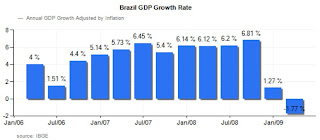
Although it was once laden with debts, Brazil managed to ride on strong commodity dollars in 2006 and 2007 and drew some U.S.$160 billion into the central bank's reserves, giving it a strong current account surplus. It’s growth can be attributed largely to the successful leadership of its president Luiz Inacio Lula da Silva, currently in his second term. One of his biggest contribution was to reduce inflation significantly, from a roaring 17.5% in 2003, to a stable 4% today. Even in a gloomy 2008, Brazil’s GDP increased 5.4% to US$1,463bn, the fastest rate of growth since 2004. Total Brazilian international reserves (US$196bn) now exceed the total foreign debt (US$163bn) by more than US$30bn, a fact that should allow Brazil to achieve a risk classification of 'investment grade'.


Of course, Brazil was not unscathed by the sliding stock markets due to the sub-prime crisis. The stock exchange, the Bovespa, fell more than 30% in the period between 2008 and 2009. And this is precisely why JNP is moving aggressively into this emerging market, viewing it as a highly attractive investment region.

Looking into the future, Brazil’s favourables remain strong. As China has overtaken the United States to become Brazil’s single biggest trading partner, its unstoppable rise will contribute a big part to the future of Brazil. Brazil also has huge new sources of offshore oil and is the world's largest exporter of ethanol, which could give it an important role in helping the U.S. wean itself from Venezuelan crude oil and shift to cleaner sources of energy. The country is also experiencing a rapid rise in the "middle classes" which is growing by over 8% per annum. This has a high chance of mirroring the growth of China which sees its domestic population buying a huge quantity of their own produce, reducing the dependance of exports. And not insignificantly, should Rio de Janeiro’s bid to host the Olympics in 2016 be successful, the associated prestige and infrastructure investment gives it a very high chance of leap frogging its growth way ahead of other emerging economies.

As Brazil’s President Lula once said: "Important banks - very important banks - that spent their lives giving advice about Brazil and what we should or shouldn't do are now broke. Brazil is more prepared than any country in the world to deal with the new global economic landscape, and has been preparing for some time to become a solid economy."

Read more...

The H1N1 crisis and your portfolio

In 2003, when Asia was hit by SARS, fear-stricken Asian markets fell consecutively for months, easing up only when the World Health Organisation lifted its advisory against travelling to SARS-affected countries. Shares of hospitality industry-related companies and airlines bore the brunt of panic-selling as punters expected they would be hardest hit by the epidemic.

With the onset of the H1N1 crisis, will we see a repeat of the SARS situation. Will this be an uncontrollable outbreak that brings ‘hope’s of economic recovery spiraling to the bottom?
Approximately 2 months since the seriousness of H1N1 was made known to the public, news of more infections continue to be reported. Every day seems to bring an exponential increase in the number of infections and a steadily-creeping death rate. Indeed, fear continues to seize investors. But, are there grounds for such fears? Let’s take the time machine back to two significant moments in our market history and see if we can learn any lessons from them.

With SARS, close to 8000 lives were affected and 800 died from it. In April 2003, with no warnings given, MSCI Asia rallied by close to 30% in the following four months.
The September 11 attack in 2001 caused the US Dow Jones to suffer a historic one-day drop of 680 points from its peak of 11,000 points, or an equivalent of 7.1%. By the end of that week, the Dow had fallen 1,369.70 points, or 14.3%. A recovery attempt allowed the index to close above the 10,000 level for the year.

Drawing references from history alone may not portray the current recession accurately, for it is true that the fundamentals of the economies today, especially that of the United States, are a lot weaker compared to the past. But one point remains relevant - whenever there is prominent negative news, the media will exaggerate its impact by many folds. To give you more perspective, the total number of people in the Western Pacific region infected by dengue in 2008 is around 210,000, with 671 reported dead. Add the numbers from Asia, where humidity and heat make dengue more rife, and you will have an idea of how much larger the number we are looking at really is. However, very Interestingly, dengue has never caused much panic or excitement in the stock market.

But of course, as the media toys with the sentiment of traders, we ought to harness the volatility that results from it. As Warren Buffet once said, if there is no volatility in the stocks market, he would rather be a beggar on Wall Street! JNP subscribes strongly to his point when it comes to our investment philosophy: positioning your investment portfolio strategically to reap long term gains over inflation, as well as riding through the current market noises to make your portfolio a stable, or even a profitable one. With that, let us examine if the gloom of the H1N1 crisis, coupled with a staggering economy can provide us with gems of investment opportunities.

Casually browse through the Internet or turn to the business section of the newspapers and you should, by now, realise that healthcare sector is an extremely hot topic. As early as two months ago when H1N1 first made the headlines, our advisers were strongly encouraged to help their clients buy into the healthcare sector. We had no idea at that moment how widespread the infections would turn out to be, but we issued that advisory for two strategic reasons. Firstly, should the situation worsen, the media would predictably exaggerate it, dragging down world markets and prolonging the downturn. Because of this, we believed that prudently and astutely-chosen healthcare sector-related stocks would help cushion the impact on our clients’ portfolios. Secondly, even if the then-called “Swine Flu” episode quickly subsided, healthcare would remain a globally-critical sector, especially for a worldwide ageing population.

Having said so, we should be cautious not to take gambles on obscure biotechnology firms whose products’ success in clinical trials remain unknown. For example, in 2001, shares of a small company called Vital Living Products surged more than 1,500% from mid-September to late October as traders bet that the company, which rushed to develop a home water testing kit for anthrax following 9/11, would soon be selling the kits nationwide in the US. That didn't happen. A month later, Vital Living stopped marketing the kits after the FBI raided its offices and the company was delisted in 2002.

Looking at the massive financial stimulus that US government is injecting into its flagging economy, JNP strongly believes that even if the recession does not completely bottom out soon, the US economy will, at best, recover with the aid of a permanent life-support system. As the US remains the world’s predominant economy and trading entity, it will call for more prudence when evaluating your investment portfolio. But there is definitely no reason to expect doom and gloom. For when it comes to investing, do remember a simple fact. Stock markets are created by humans, whose actions are largely dictated by emotions. No sane person would deliberately cause the stock market to fall into a black hole, for that is simply mutually-assured destruction.

In that light, the market be said to have a wisdom of its own, with its ability to rally ahead in spite of the bad news and dismal numbers on paper. That is the intrinsic nature of the market and it will remain that way as long as the global financial system, as we know it, survives. So, as an investor, continue to wear a hopeful hat when you step out into the market, and hold tightly to the hands of your adviser who will walk you through the ups and downs of this exciting, but definitely rewarding investing journey.

Read more...

Bottoming out? Not so fast...

By Patrick Tan


There has been talk of late, that the global recession is “bottoming out”. But if history has taught us anything, the road ahead looks set to be bumpy still.

The current meltdown has been described as the worst financial crisis since the Great Depression. Let us look then at the very period that today’s crisis is being compared to. When the American stock market crashed on October 29, 1929 (a day which has come to be known as Black Tuesday), it pulled the rest of the world down with it; much like what is happening today. Between 1929 and 1932 there were no less than six market rallies which were believed to by analysts then to be recoveries. Alas, each of those perceived “recoveries” were false starts. Today’s economists, with the benefit of hindsight, believe that true and sustainable recovery began only the following year, in 1933. In all, it took five years for the Great Depression to truly bottom out. Therefore, if history is a guide, talk about the current crisis bottoming out now is, to my mind, naively premature.

Plagued by balance sheet crises, stratospheric debt, credit strangulation and plummeting property values, pandemonium still reigns in the American market. It will continue for some time yet. While the Asian economies are expected to recover slightly before the American market, they too will take some time to struggle out of the doldrums. In the meantime, investors should be prepared to see more peaks and valleys in the months ahead. But we serious investors should remember Franklin Roosevelt - who, incidentally, was the president credited with helping the American economy recover from the Great Depression - who said that “we have nothing to fear but fear itself.”

Indeed, fear - and greed - drives the actions of market speculators who influence the market with their knee-jerk reactions and wild gambles. Investors, on the other hand, have time-honoured strategies that will see them through this period. They, on the whole, will emerge from this turmoil in better shape than the speculators.


Hold on with faith to the financial plan that you and your adviser have devised together. If you are currently allocating a portion of your income to your investment plan, continue with it. The practices of dollar cost averaging and value cost averaging are tried and true. Study after study has shown that adherence to these strategies will stand a disciplined investor in better stead than one who pulls out when times are bad.

The financial plan that our clients have are individually-crafted and take into account factors such as their goals, investment horizons, psychological propensity, financial capacity and current economic condition. It is precisely when times are bad that we need the discipline to adhere to our plans. Stay true to it and it will stay true to you. Your plan is the shock absorber that will help your finances withstand the bumpy ride ahead.

Patrick Tan is the founder and Partner of JNP Group. He is also serves as a Director on IPP's Board of Directors.

Read more...

China’s late-bloomer advantage in the current crisis

By Patrick Tan, Founder and Branch Partner

One man’s poison is another man’s meat, so the saying goes. As far as the current financial crisis is concerned, the toxic debts and assets poisoning the economies of some of the most affluent countries in the world represents a prime cut of meat for China’s growth. The fact that China’s economic rise will be astounding and unprecedented cannot be doubted, thus investors should understand why this crisis will be pivotal to its growth.

Although China is already the third-largest economy in the world, it still has a long way to go before it can pose a real challenge to America – its GDP stands at US$4.3 trillion compared to the US$14.26 trillion economy of the US. But China finds itself faced with a golden opportunity to play catch-up while the rest of the developed world is mired in the current economic mess caused by their own regulatory mismanagement.

It is no secret that, armed with the world’s largest foreign exchange reserves estimated at US$1.95 trillion, China is able to make significant upgrades to its infrastructure without relying on external financing. This, in part, has allowed its domestic banks to de-leverage in recent years and the country to remain relatively unscathed by the current turmoil. That in itself gives it a major advantage while its competitors writhe in over-leveraged agony and debt.

Another significant factor is China’s advantage as a late-bloomer. In the later part of the Twentieth Century, while developed countries spent massive sums upgrading their communication infrastructure – laying cables and investing in other hardware, China – then still adhering rigidly to a Communist economic model – missed out on that revolution. Today however, a resurgent China is able to pump its capital into developing a modern wireless infrastructure without having had to go through the wired phase, effectively leapfrogging an entire generation of technology and saving itself billions of dollars.

This crisis will also allow China to relatively easily remodel its still-developing economic growth engine, driven by different sectors requiring different job market skills. If I placed myself in the Chinese government’s position, I would be gleefully opportunistic with the current turmoil.

China is taking strong steps this year to cement its economic rise in tandem with an inevitable global recovery. According to the IMF, the central government is significantly increasing its spending on critical social programmes in 2009. Healthcare spending will increase 38% on year, education will go up 24% and investments in social safety nets will rise 22%. Consider these increments while almost all its developed competitors are wracking their financial nerves and slashing their national budgets.

The central government is also boosting the consumption rate of its formidable rural market – estimated at more than 700 million – by giving them a subsidy of 13% for the purchase of appliances such as colour TVs, refrigerators, washing machines, cellphones, computers, air conditioners and microwave ovens, etc. Other efforts to stimulate consumption include a programme to increase the number of stores and distribution centres in rural areas while renovating and standardizing rural food markets.

With the transformed infrastructural landscape and increased standards of living, investors can be confident urban and suburban property values will rise and stabilize in the medium-to-long term while equities in the manufacturing, financial and shipping industries – to name a few – will also be primed for a boom.

But even with everything going for it, China’s growth can only rebound significantly and in a sustainable manner when the world’s economy fully recovers. And this is unlikely to happen soon. To be sure though, with a general sentiment of lost confidence in the US and European markets, funds will continue to gush into China, setting the stage for its GDP to skyrocket in the medium-to-long term.

While some like to think of China in its current state as a waking dragon, I prefer to see it as a mere lizard with the potential to evolve into a dinosaur. The contrast between the China of today and the China of the next decade-or-so will be mind-boggling. With 1.2 billion people hungry for growth, a strictly-regulated financial system and a brilliant, stable and efficient central government, the country is primed to be a significant actor in the next bull-run. Investors have every reason prepare for it now.

Read more...

About This Blog

“Kaki” is used to describe close friends with whom we share a special relationship. The unique thing is that they meet up regularly, they talk, they have fun, and they often take a genuine interest in each other’s lives. Most importantly, they share a meaningful time together, sharing knowledge and exchanging ideas.

What's New ?


  © Blogger templates Psi by Ourblogtemplates.com 2008

Back to TOP